Bandhgala
Closed at the collar, in black
Priced at the atelierOnce the cloth is chosen. The cloth sets the final price, confirmed at the atelier.
The garment
A bandhgala is judged at the closed collar: its height, how it stands against your neck, the line it draws to the shoulder. We build it like a tuxedo jacket underneath, so it holds its shape through a long evening. Ours opens in black, worn with ivory trousers.
What is included
The sitting, a pattern drafted for you and kept on file, and two fittings.
The cloth and the price
Priced at the atelier once the cloth is chosen. The cloth sets the final price, confirmed at the atelier. What the cloth costs →
Aftercare
We press, adjust and repair the garments we make. When we take your measure, a piece that does not fit as agreed is altered or remade at our cost within thirty days of delivery.

Black, closed at the collar, worn with ivory trousers.
Your cloth is shown as a swatch and at your fitting.
Cut
Bandhgala collar · Plain trousersCloth
BlackThe cloth
Midnight and black worsteds for formal evenings, and silks and jacquards for weddings, including cloth from Indian looms.
Worsteds, silks and jacquards, chosen in the hand.
The making
A pattern drafted from your measure and kept on file. Cut by hand in Worli and fitted closed, the way it is worn.
A pattern drafted for you, cut by hand in Worli.
The fittings
One sitting to take your measure, then two fittings: first in the basted shell, then close to finished.
One sitting, then two fittings.
The time
Four to five weeks, from the sitting to the last fitting. For a wedding, begin twelve weeks out.
Four to five weeks. For a wedding, begin twelve weeks out.
The details
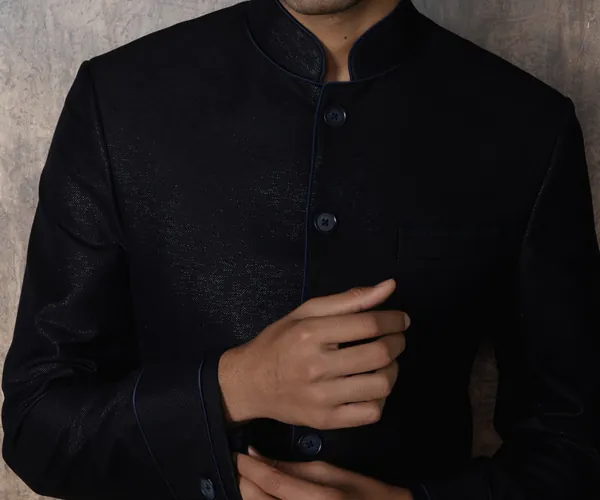
The front
Closed on self buttons · a tonal jacquard, in black.
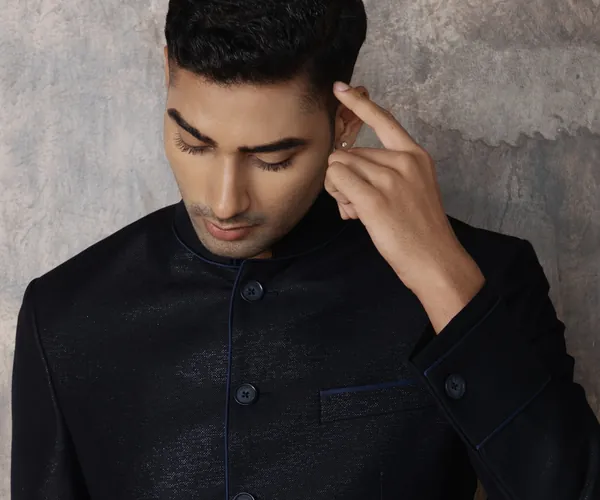
The collar
The standing collar · how it sits against the neck.
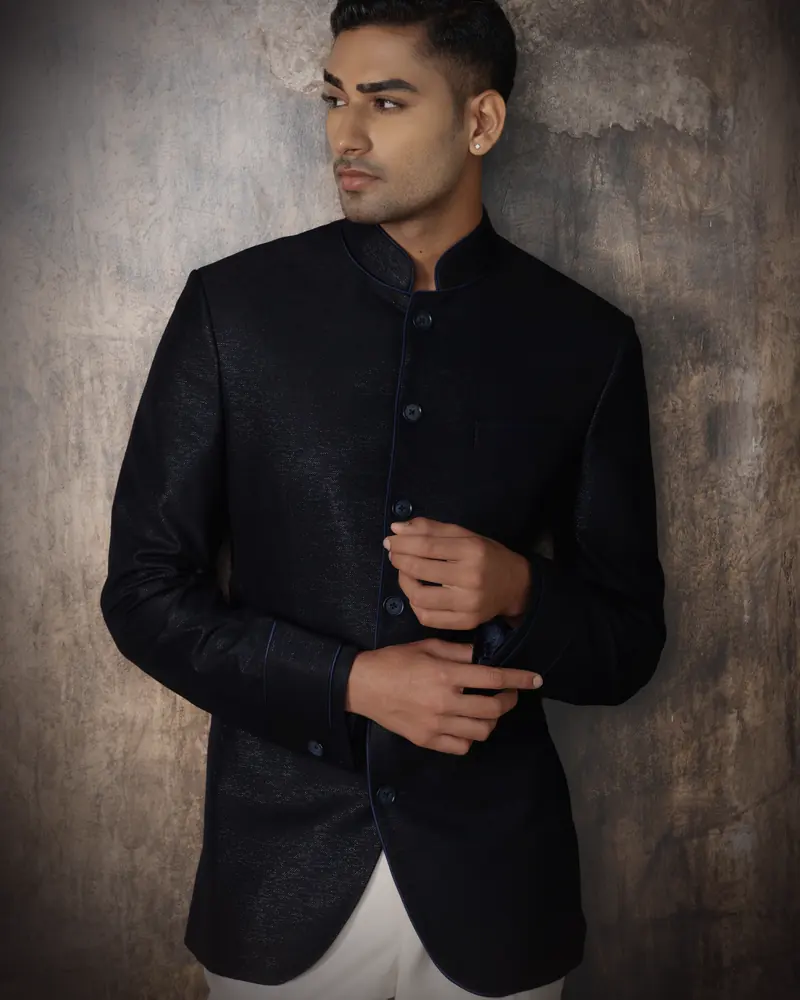
Worn
The same bandhgala, closed · with ivory trousers.
Asked before a first bandhgala
Bandhgala or sherwani?
The bandhgala is for the evening: dinners, receptions, award nights. The sherwani is for the ceremony. For a wedding week, many grooms have both.
Can it work for business?
A dark worsted bandhgala sits in a boardroom as naturally as a suit. It is formal in Indian and Western settings alike.
Jodhpuri trousers or plain?
Either. Plain trousers keep it modern; the fuller jodhpuri cut is more ceremonial. We cut both to the same measure.
What should the first one be?
Midnight, near-black or another deep colour: a bandhgala that works for every invitation. Brocade can come second.
Commission it from your wardrobe.
Your figures are on file; the house confirms every detail with you before anything is cut.